
Lights, Camera, AI
How Healthcare Providers Can Dominate Video Marketing Without Ever Touching a Camera

The Real Obstacle to Video Marketing Isn’t Technology
For years healthcare practitioners have heard the same advice repeated in marketing seminars, webinars, and industry conferences: “You need to be on video.” Video content builds trust faster than written text, humanizes your brand, and allows patients to experience your personality and expertise before they ever walk through the door. It is also one of the most effective ways to educate patients and generate engagement across social media platforms. Despite understanding these benefits, however, many chiropractors and multidisciplinary healthcare providers still hesitate to use video consistently.
The hesitation rarely comes from disbelief in the value of video marketing. Most clinicians recognize that video is powerful, but they assume the process is too complicated or time-consuming to maintain. Cameras, lighting, editing software, scripting, and production timelines can make video creation feel like a completely separate profession layered on top of patient care and business operations. For busy healthcare professionals, the idea of mastering media production can seem unrealistic.
Yet the biggest barrier preventing many practitioners from embracing video may simply be a lack of awareness about how dramatically the technology has evolved. Artificial intelligence is now capable of performing many of the tasks that once required specialized equipment and professional editing skills. What once required hours of filming and post-production can now be accomplished in a fraction of the time.
At recent technology conferences, demonstrations of AI-generated avatars revealed presenters so realistic that they were nearly indistinguishable from real people. These digital presenters blink naturally, gesture while speaking, and communicate with lifelike rhythm and tone. Some avatars are even multilingual, while others can replicate the voice and likeness of a real clinician. With this technology now readily available, healthcare providers are entering a new era in which video marketing can be produced quickly, efficiently, and at scale.
Why Consistency Matters More Than Perfection
Before discussing the technology itself, it is important to understand why frequency of video production matters so much in healthcare marketing. Today’s healthcare consumers live in an environment saturated with information. Every day they encounter health advice from influencers, hospital systems, telehealth companies, physical therapists, nutrition coaches, and fitness personalities competing for their attention.
In this crowded landscape, visibility often determines perceived authority. Marketing research consistently demonstrates the power of what psychologists call the mere exposure effect, which describes how individuals develop familiarity and trust through repeated exposure to a message or person. In practical terms, the healthcare provider whose educational videos appear regularly in a patient’s social media feed often becomes the trusted expert.
This dynamic means that sporadic video posting rarely produces strong results. A video once per month does little to build recognition or credibility. Even a weekly video may struggle to generate consistent exposure in today’s fast-moving digital environment. Many high-performing healthcare practices now publish educational content three to five times each week across multiple platforms.
Historically, maintaining that level of content production required hiring a videographer or working with an agency, both of which can be expensive and time-consuming. Artificial intelligence has fundamentally changed this equation by dramatically reducing the time and cost required to create professional-quality video content.
Turning an Idea Into a Video in Minutes
Modern AI video production can be understood as a three-stage workflow: scripting, production, and distribution. Each stage once required specialized knowledge and considerable effort. Today, however, artificial intelligence tools can automate or streamline much of the process.
The first stage involves creating a script. Many healthcare providers underestimate how difficult it can be to condense complex clinical knowledge into a short, engaging explanation that patients can easily understand. Clinicians often know exactly what they want to say but struggle to organize the message clearly.
AI language models trained on healthcare communication can now generate structured scripts in seconds. A practitioner might request a short video explaining how spinal alignment can improve sleep quality or reduce headaches. Within moments, the system produces a script that includes an engaging introduction, a clear explanation, and a call to action encouraging viewers to learn more.
These systems can even be trained on the practitioner’s own educational materials, blog posts, newsletters, and treatment philosophy. As a result, the scripts reflect the voice and style of the practice rather than sounding generic or artificial. This allows clinicians to scale their educational outreach while maintaining a personal and authentic tone.
Once the script is complete, production can begin almost immediately.
The Emergence of AI Avatars
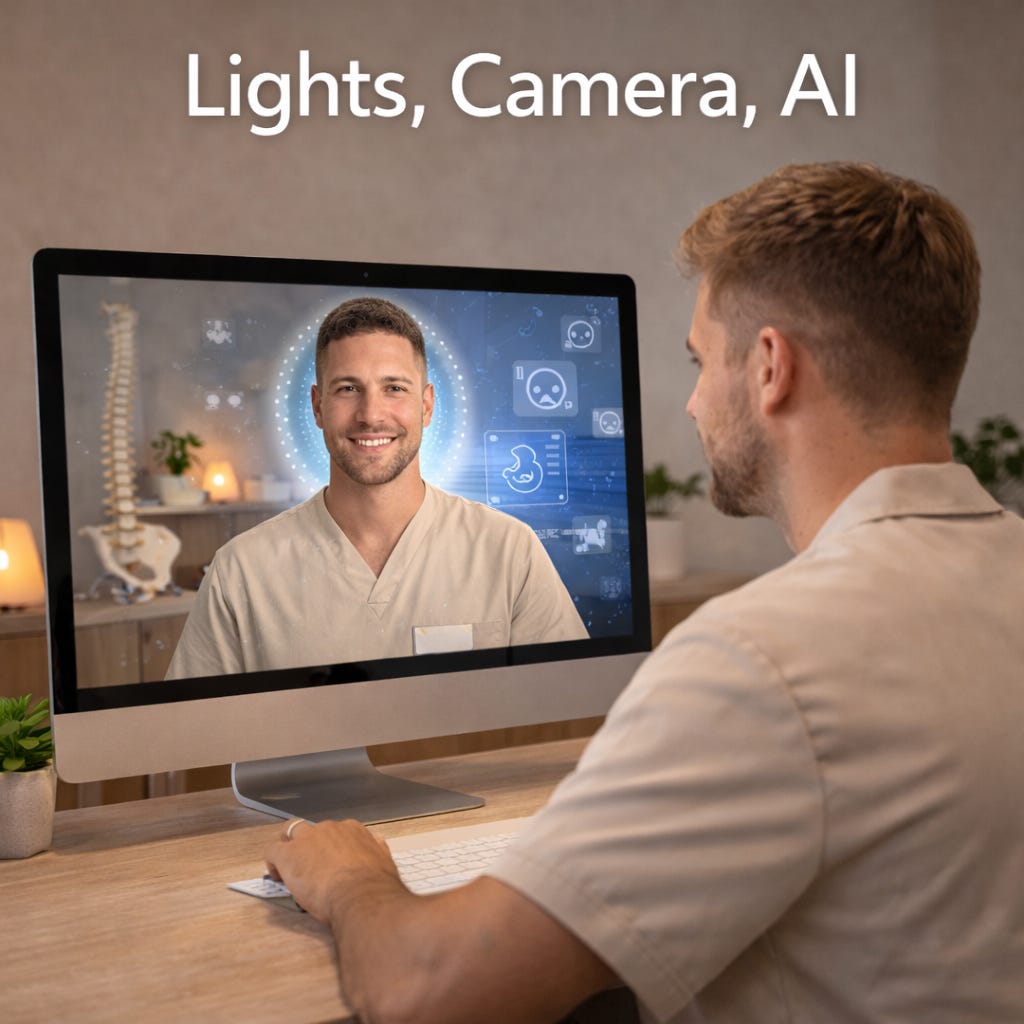
AI avatar technology has fundamentally redefined what it means to appear on camera. Instead of filming a live video, practitioners can now use digital presenters to deliver their scripts. These avatars look directly at the viewer, speak naturally, and incorporate subtle facial movements that mimic real human communication.
Some avatars function as neutral brand representatives who serve as the educational spokesperson for the practice. Others can be customized to resemble the practitioner themselves, creating what is often called a digital twin. Voice cloning technology can reproduce tone and cadence with surprising accuracy, while facial mapping allows the avatar to mimic expressions and gestures.
For camera-shy clinicians, this technology eliminates the discomfort of filming entirely. There is no need to worry about lighting conditions, camera angles, or wardrobe choices between patient appointments. Scripts can be recorded quickly and efficiently without disrupting the clinic schedule.
Even more importantly, avatars allow practices to maintain consistent video output. A digital presenter can deliver multiple educational videos in the time it previously took to film just one. This efficiency allows healthcare providers to maintain a strong online presence without sacrificing time that would otherwise be devoted to patient care.
Choosing the Right Video Format
Healthcare practices can approach AI-generated video in several different ways depending on their goals and branding preferences. One of the simplest formats involves faceless educational videos that rely on narration, visual graphics, and supporting footage rather than an on-screen presenter. These videos are especially effective for demonstrating exercises, explaining ergonomic principles, or sharing quick health tips.
Because faceless videos do not require avatar modeling or likeness licensing, they can be produced extremely quickly. Many practices use them to maintain a steady stream of educational content while reserving more personalized videos for major announcements or in-depth explanations.
Another option involves using a professional-looking digital spokesperson who appears on screen delivering educational content. These presenters provide a polished, studio-quality appearance that enhances perceived credibility and professionalism.
The most advanced option involves creating a digital twin of the practitioner. By recording voice samples and facial images, clinicians can generate a realistic digital version of themselves capable of delivering unlimited educational content. In some cases, a practitioner could produce months of video content in a single afternoon of avatar training.
Enhancing Videos With AI Visuals
Video effectiveness depends not only on spoken content but also on visual storytelling. Viewers tend to retain information more effectively when explanations are supported by images, demonstrations, or contextual visuals. AI tools can now automatically generate or insert relevant B-roll footage that enhances the message.
For example, a video discussing posture correction may include visuals of spinal models, workstation ergonomics, stretching exercises, or patient consultations. These visuals appear seamlessly within the video timeline, creating a more engaging and dynamic presentation.
Captions also play a critical role in modern video performance. A large portion of social media users watch videos with the sound turned off, particularly when browsing on mobile devices. AI captioning tools automatically generate synchronized text and format captions with color highlights and animations that improve readability.
These visual enhancements help maintain viewer attention and increase the likelihood that educational messages will be fully understood.
Simplifying Post-Production
Editing has traditionally been one of the most technically demanding aspects of video production. Tasks such as trimming footage, balancing audio, adding transitions, and inserting graphics often require specialized software and training. For clinicians without a background in media production, these tools can feel intimidating.
Artificial intelligence has dramatically simplified post-production by automating many of these steps. Modern editing systems can automatically remove awkward pauses, eliminate filler words, enhance audio quality, and apply branded visual templates.
What once required hours of work in professional editing software can now be completed in minutes using browser-based platforms. Some systems even optimize videos for different social media platforms automatically, converting a single recording into vertical reels, square posts, and horizontal YouTube formats.
For healthcare practitioners, this automation removes one of the final barriers between creating an idea and sharing it with the public.
Expanding Reach Through Automated Distribution
Creating videos is only part of a successful marketing strategy. Equally important is ensuring that the content reaches the intended audience. Artificial intelligence now makes it possible to distribute video content across multiple platforms with minimal effort.
AI-driven social media managers can schedule, publish, and repurpose videos across Instagram, Facebook, TikTok, YouTube Shorts, and LinkedIn simultaneously. These systems automatically generate captions, hashtags, thumbnails, and posting schedules based on engagement data.
More advanced platforms analyze viewer behavior and recommend future content topics. If videos about neuropathy generate stronger engagement than general back pain content, the system can suggest creating additional videos on that subject. Over time, this creates a self-improving content strategy based on real patient interest rather than guesswork.
This approach allows healthcare practices to maintain a consistent digital presence without hiring a dedicated marketing team.
Maintaining Authenticity in an AI World
As AI-generated video becomes more common, many practitioners wonder whether patients will perceive this content as authentic. Research in digital communication suggests that authenticity is driven more by message relevance than by production method. Patients respond to clear explanations, relatable examples, and evidence of expertise regardless of how the content was produced.
However, transparency remains important in healthcare communication. Practices that use digital twins or AI-generated presenters should disclose this appropriately when necessary. Maintaining honesty about how content is created helps preserve patient trust.
Many healthcare providers choose a hybrid strategy that combines AI-generated videos with occasional live recordings. AI content can maintain consistent posting frequency, while live videos can be used for patient success stories, community outreach, or personal messages from the doctor. This balanced approach combines efficiency with authenticity.
The Financial Advantage of AI Video
From an economic standpoint, AI video production offers significant advantages. Traditional video shoots can cost thousands of dollars when factoring in videographers, editing services, and studio equipment. In contrast, AI platforms typically operate on subscription models that allow unlimited content production for a fraction of the cost.
More importantly, consistent video marketing can directly influence practice growth. Healthcare practices that regularly publish educational videos often report improved patient conversion rates, higher case acceptance, and stronger patient retention.
When patients feel that they already know and trust the doctor through online content, consultations begin with a relational advantage. The first appointment becomes less about establishing credibility and more about confirming the trust that has already been built through digital education.
From Best-Kept Secret to Community Authority
Many excellent healthcare practices describe themselves as the “best-kept secret” in their community. While this phrase may reflect clinical excellence, it also highlights a marketing challenge. Exceptional care does little good if potential patients are unaware of the services available to them.
AI video technology provides a powerful solution to this visibility problem. Educational videos covering topics such as sciatica, regenerative medicine, sports injuries, pediatric chiropractic care, or functional nutrition can now be produced regularly without disrupting clinic operations.
Each video becomes a digital introduction that allows potential patients to experience the practitioner’s expertise. Over time, repeated exposure builds familiarity and trust within the community.
Eventually, patients stop asking, “Who should I see?” Instead, they say, “I’ve been watching your videos and wanted to come meet you.”
The Next Frontier: Personalized Video Education
The future of AI video extends beyond marketing and into patient education. Emerging systems are beginning to generate personalized video explanations based on patient diagnoses, treatment plans, or intake information.
Imagine a patient receiving a customized video explaining their condition, expected outcomes, and recommended lifestyle changes. The message could be delivered by the practitioner’s digital twin, creating a personalized and engaging educational experience.
Other platforms are exploring real-time translation capabilities that allow healthcare providers to communicate effectively with patients who speak different languages. These innovations could significantly expand access to care for diverse populations.
As these technologies evolve, video communication will become an increasingly important part of the patient experience.
A New Era of Healthcare Visibility
Healthcare and artificial intelligence are now intersecting in ways that were unimaginable only a few years ago. The clinicians who adopt these tools early will help shape the future of healthcare communication in their communities.
Video is no longer limited to media professionals or large hospital marketing departments. Today, chiropractors, therapists, and multidisciplinary providers can produce professional video content quickly and efficiently using AI-powered tools.
With automated scripting, lifelike avatars, simplified editing, and intelligent distribution systems, a single idea can be transformed into a polished video within minutes. These technologies allow healthcare professionals to share their expertise consistently without sacrificing time spent caring for patients.
The real question is no longer whether practitioners have the time to create videos. The real question is whether they are ready to step into the spotlight and share their knowledge with the communities they serve.
MARK SANNA, DC, ACRB LEVEL II, FICC, is the CEO of Breakthrough Coaching, a practice management company for chiropractic and multidisciplinary practices. He is a Board member of the Foundation for Chiropractic Progress, a member of the Chiropractic Summit, and a member of the Chiropractic Future Strategic Plan Leadership Committee. To learn more, call 800-723-8423 or visit mybreakthrough.com.
Top of Form